Introduction
In today’s digital world, data is everything. Nowadays, data is treated as gold by many big tech and finance companies, but no one has wondered why.
It is because the data is a powerful resource that helps big companies and organisations to make decisions, make powerful innovations, and shape the future of every industry. Nowadays, a massive amount of data is generated through smartphones, online shopping, and many other apps and digital interactions.
But this raw data is of no use until and unless an experts transform the raw data into something insightful and valuable so that it can derive some conclusions and insights for the business. For this, the data analyst comes into the frame.
Who is a Data Analyst?
A data analyst is a professional who plays with data all day long. His main task is to collect, process, and interpret data to help businesses and organisations make insightful decisions, which would help organisations grow.
In simple words, a data analyst is someone who works with data and finds insights and patterns and derives logical conclusions from it, which would eventually help organisations and businesses to grow.
How Does a Data Analyst Work?
Aswe understood that a data analyst is a professional who manages the data and derives meaningful insights from it and which helps organisations and industry to grow
The key responsibilities of a data analyst are:
- Collecting data
- Cleaning of sorting of data
- Analysing the data
- Visualising the insights
- Interpreting the results
- Delivering the results to the client
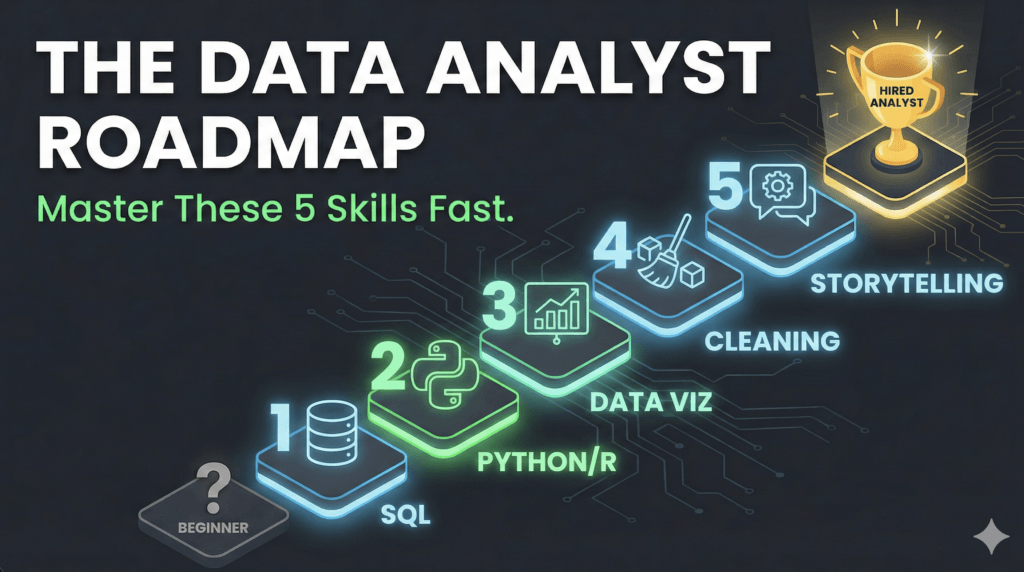
Top 5 essential skills to become a data analyst
To become a successful data analyst, a person needs strong technical as well as analytical skills. Only then can he or she become a good data analyst. Below mentioned are the top 5 skills everyone needs to learn to become a successful data analyst are as follows:
Skill 1 : SQL (Structured Query Language)
SQL is referred to as structured query language. It is one of the most important languages or tools to become a data analyst .SQL is widely used in many companies to access and manage data which is stored in databases. Nowadays, most company and large organisations store their valuable data in a database and with the help of SQL, the data analyst can extract data from these databases and work on it. SQL allows an analyst to extract meaningful information from the database with the help of queries and perform meaningful insights on that data. With the help of this powerful tool, an analyst can sort, join and calculate a summary of multiple data sets at a single point in time. Without SQL, working with large data could have become very difficult, but with the help of SQL, it is just simple, easy and quick.
Skill 2 : Programming Language (Python or R)
In the journey of a data analyst, programming language plays a pivotal role; these are referred to as the base or basics of this career. Programming languages like Python or R are powerful tools for a data analyst, which are used to perform advanced and deeper analysis of the data. Python and R allow analysts to clean, transform and analyse data and derive logical and meaningful insights from it. These languages handle large datasets efficiently. Especially, the Python programming language comes with libraries like pandas, numpy, matplotlib and seaborn that directly help in the analysis of data. These languages are used to make models, create dashboards and automate tasks and many more things. Many complexities in the data could be easily handled by these programming languages efficiently.
Skill 3 : Data Cleaning and Preparation
Data cleaning and preparation is one of the most important tasks of an analyst because the raw data, which is extracted from databases and many other resources, may contain duplicate values and not be organised properly. So if we process this unorganised data, the insight would not be meaningful. So, before any analysis is done, it is highly recommended that the data be cleaned properly and managed effectively and then only should one start with the analysis part. Proper data preparation includes transforming data so that it can be easily analysed and visualised, so that local and meaningful insights can be drawn from that. That’s why data cleansing and preparation are considered an essential step of data analysis.
Skill 4 : Data Visualization (Excel, Power BI, Tableau)
Data visualisation is the key and the most crucial part of data analysis because in this stage, the transformed data and the insights and conclusions are to be shown to the client or higher authority and presented in such a manner that if a person is not familiar with the numbers, he or she could easily understand them. This transformation could only be possible with the help of tools such as Excel, Power BI, Tableau, etc. These tools help an analyst present insights to the client and view trends, and perform comparisons through visuals. Data visualisation helps data analysts highlight important terms and insights, track performance, and communicate results effectively.
Skill 5 : Communication
Communication is the most important soft skill of a data analyst because if the person does not know how to communicate the conclusions or derived insights to their client, that analysis is useless. Communication is a very important part, as the analysis is only valuable when insights are clearly explained and understood properly. A data analyst must be able to translate complex and technical findings from that data so that a meaningful conclusion can be made out of it. This includes writing clear reports, making good and valuable dashboards, explaining trends and answering all the meaningful questions about the data. Good communication ensures better understanding among the people, and better decisions and projects run smoothly.
My Views on this topic
In my view, the role of a data analyst is very important for an organisation to derive useful insights from its raw data. They need someone who could convert gold from their raw data in where a data analyst comes in place. Every industry, from healthcare to finance and retail to technology, depends heavily on data to understand trends, improve performance and make better decisions. A skilled data analyst fulfils the gap between numbers and business decisions, helping many businesses and organisations to work more smartly and effectively. This is my strong belief that as the data continues to grow, the demand for data analysts in the market also increases, making it a great career to pursue.
Conclusion
By concluding this blog, data analysis has become a great skill to learn in today’s digital world, where everything evolves around data, and everything needs to be analysed to make meaningful insights from cleaning and preparing data to analayze patterns and visualizing trends and transforming raw data into valuable and meaningfull insights as data continous to grow the demand for data analsyt and data scientists also grows, making it a promising and impactful career choice.