

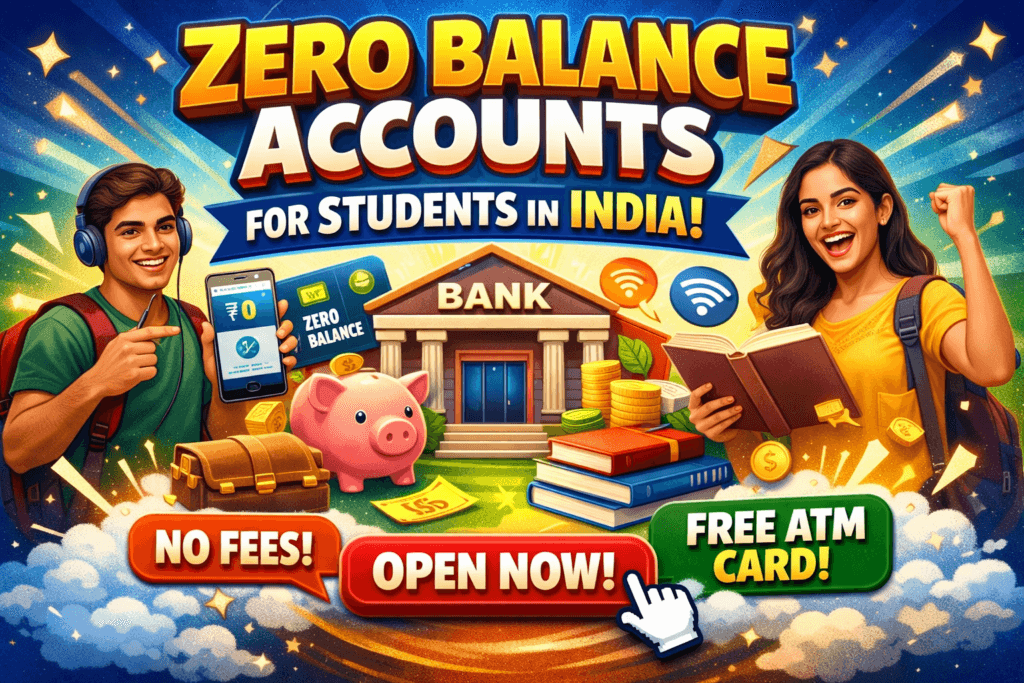
Managing money as a student often feels like a high-stakes balancing act. Between those heavy tuition fees, the endless stream of subscriptions, late-night food runs, and that one “I definitely shouldn’t have bought this” impulse purchase, staying on top of your finances can be a real headache.
That’s exactly where Zero Balance Accounts for Students come to the rescue.
Whether you’re navigating the busy campus life at Christ University in Delhi NCR, or studying in the heart of Bangalore or Mumbai, having a bank account that actually works for you—and not against your wallet—is a total game-changer. In this guide, we’re breaking down everything you need to know about Zero Balance Accounts for Students: how they differ from those old-school savings accounts, and which banks in India are actually worth your time.
Why Are Zero Balance Accounts for Students?
Think of Zero Balance Accounts for Students as your financial safety net while you’re busy hitting the books. These aren’t your typical, stuffy bank accounts; they’re specifically built for students who are just starting to manage their own money. The absolute best part? You aren’t forced to keep a single rupee in there if you don’t want to.
In a standard savings account, banks usually play the “Average Monthly Balance” (AMB) game. If your balance drops below their limit—say, after a big weekend out or paying for a new certification—they hit you with those annoying “low balance” penalties. But with Zero Balance Accounts for Students, that stress is gone. You can have exactly ₹0 in your account and the bank won’t charge you a paisa in fines.
Generally, these accounts are a perfect match for:
- The 10–25 Age Bracket: (Though this varies slightly depending on which bank you pick).
- Active College or University Students: Whether you’re pursuing a BCA or any other degree.
- Banking Newbies: Anyone looking to ope
Difference Between Zero Balance Account and Normal Savings Account
Choosing the right account is all about knowing what fits your lifestyle. To make it simple, let’s look at how Zero Balance Accounts for Students stack up against the “Normal” accounts our parents usually have.
Think of it as the difference between a flexible subscription and a heavy commitment.
| Feature | Zero Balance Accounts for Students | Normal Savings Account |
| Minimum Balance | ₹0 (Zero)—Freedom to spend every last rupee. | ₹1,000 to ₹10,000—A portion of your money stays “locked.” |
| Penalty Charges | None. No stress if your balance hits rock bottom. | Hefty fines (₹200–₹600+) if you dip below the limit. |
| Target Users | Students & Gen-Z who want digital-first banking. | Working Professionals & the general public. |
| Debit Card | Often Free or Highly Discounted (Digital cards are 100% free). | Chargeable annually (usually ₹150–₹500 + GST). |
| Daily Vibes | Simple & Digital. Everything happens on your phone. | Full-Service. Better if you need physical branch visits or high-value loans. |
Top 5 Best Zero Balance Savings Accounts for Students in India
Below are five popular banks offering strong options for Zero Balance Accounts for Students. This list is for informational purposes — you should compare features before making a decision.
1. State Bank of India – SBI Student Plus Account

SBI offers a Student Plus Account linked to education loans.
Key Features:
- Zero minimum balance
- ATM-cum-debit card
- Internet & mobile banking
- No charges for non-maintenance
Best For:
Students who already have or plan to take an education loan from SBI.
Apply Here:
https://sbi.co.in/web/personal-banking/accounts/savings-account/student-plus
2. HDFC Bank – DigiSave Youth Account

HDFC provides youth-focused digital savings accounts suitable for students.
Key Features:
- Zero balance variant available
- Digital account opening
- Free debit card (conditions may apply)
- NetBanking & mobile app access
Best For:
Students comfortable with digital banking and UPI-based transactions.
Apply Here:
https://www.hdfcbank.com/personal/save/accounts/savings-accounts/digisave-youth-account
3. ICICI Bank – Young Stars / Student Account
ICICI offers youth and student-oriented savings accounts with zero balance features.
Key Features:
- No minimum balance requirement (student variant)
- Free debit card
- Online banking access
- ATM withdrawals nationwide
Best For:
Students who want wide ATM access and strong digital services.
Apply Here:
https://www.icicibank.com/personal-banking/accounts/savings-account/young-stars-account
4. Bank of Baroda – Baroda Champ / Student Account

Bank of Baroda provides student-friendly accounts under its youth banking offerings.
Key Features:
- Zero minimum balance
- RuPay debit card
- SMS & mobile banking
- Basic accidental insurance cover (subject to conditions)
Best For:
Students looking for a public-sector bank option with simple features.
Apply Here:
https://www.bankofbaroda.in/personal-banking/accounts/savings-account/baroda-champ
5. Kotak Mahindra Bank – 811 Digital Savings Account

Kotak 811 is a fully digital zero balance savings account popular among students.
Key Features:
- Zero balance requirement
- Instant online account opening
- Virtual debit card
- UPI & app-based banking
Best For:
Students who want a completely paperless, branch-free banking experience.
How to Choose the Right Zero Balance Account
Choosing the right account isn’t just about avoiding fees—it’s about finding a tool that makes your life easier. Before you hit “Apply,” here’s a quick checklist to ensure you’re picking the best Zero Balance Accounts for Students for your specific needs.
1. The ATM Reality Check
While the account itself is free, some banks limit you to 3 or 5 free ATM withdrawals a month. If you’re someone who prefers carrying cash for campus canteen runs, look for banks like Standard Chartered or IDFC First, which often offer unlimited or higher free withdrawal limits.
2. Watch Out for “Card Fees”
Here’s the catch: even if the account is “zero balance,” the plastic in your wallet might not be. Some banks charge an annual maintenance fee for physical debit cards (usually ₹150–₹250). If you’re strictly a UPI user, go for a bank like Kotak 811, which offers a Virtual Debit Card for ₹0.
3. Test the App (Digital-First Only!)
As a student, you probably won’t step foot in a physical branch more than once a year. Your bank is the app. Check the Play Store ratings for their UPI speed and UI. Neo-banks like Fi or Jupiter (built on Federal Bank) are designed specifically for our generation and feel much smoother than old-school banking apps.
4. Hunt for the “Hidden” Charges
Banks can be sneaky with the small stuff. Keep an eye out for:
- SMS Alert Fees: Some charge ₹15–₹30 per quarter.
- Cheque Book Charges: Usually only the first one is free.
- Insufficient Balance Fines: Some banks charge you if a subscription payment (like Netflix or Spotify) fails because your account was empty.
5. Think About the “18 to 25” Transition
Most Zero Balance Accounts for Students have an “expiry date”—usually when you turn 21 or 25. Ask yourself: What happens then? Some accounts automatically convert into “Normal” accounts that require a ₹10,000 balance. Pick a bank that makes this transition easy or offers a “Zero Balance for Life” switch.
What are the Benefits
Why should you actually care about these accounts? It’s not just about avoiding a few fees; it’s about making your life as a student easier. Here’s why Zero Balance Accounts for Students are a total game-changer:
- Zero Stress, Zero Fines: You can focus on your exams (or your social life) without constantly checking if you have enough “minimum balance” to avoid a penalty. If your account hits ₹0, it stays ₹0—no negative balances here.
- A Head Start on Money Management: It’s like financial training wheels. You learn how to track your spending and save for that next big purchase without any high-stakes risks.
- Digital-First Freedom: Most Zero Balance Accounts for Students are built for the smartphone era. Setting up UPI for a quick tea at the canteen or paying for your Spotify and Netflix subscriptions is seamless.
- The Perfect Internship Partner: When you finally land that internship or start a freelance gig, you need a place for those stipend credits to land. These accounts make it easy to receive payments without the bank taking a “cut” for low maintenance.
- Building Your Financial Identity: Starting an account now helps you build a “banking history.” In the future, when you want to apply for a credit card or a study-abroad loan, having a long-standing relationship with a bank really counts.
My Personal View
When you’re a student—navigating a busy schedule and trying to balance social life with studies—the last thing you want is a bank account that feels like an extra chore.
In my view, Zero Balance Accounts for Students are the perfect “starter pack” for adulting. They give you the freedom to experiment with your money without the anxiety of keeping a specific amount locked away. But, like everything else, there’s a right time and place for them.
You should definitely go for it if:
- The “Student” Label Fits: You’re under 25 and your main focus is on your degree, not a corporate salary.
- Irregular Cash Flows: Maybe you get a stipend one month from an internship and then nothing the next. These accounts don’t care about “stability.”
- First-Time Banker: You want a safe space to learn how UPI, mobile banking, and digital statements work without any financial risk.
- Penalty-Phobia: You simply don’t want to give the bank your hard-earned money just because your balance hit ₹500.
When should you think twice?
If you’ve already started a consistent freelance gig or have a steady income stream, you might eventually outgrow these. Regular savings accounts can sometimes offer slightly better interest “slabs” (basically, your money earns more once you cross a certain limit) or “Premium” support.
My Bottom Line: For where we are right now, the flexibility of Zero Balance Accounts for Students wins every time. It’s about having a bank that understands a student’s wallet.
Final Thoughts
Choosing the right Zero Balance Accounts for Students isn’t about finding the “best” bank in the world—it’s about finding the one that fits your actual life. Whether you need a sleek app for UPI or a bank with an ATM on every corner, the goal is the same: making your money work for you, not the other way around.
If you’re just starting out, a zero-balance account is essentially your financial “training wheels.” It gives you the flexibility to spend, the control to track, and the peace of mind to know you won’t wake up to a surprise penalty.
Quick Checklist Before You Apply:
- Compare the Perks: Don’t just look at the “Zero Balance” part; look at the rewards, cashback, and student-only offers.
- Go Digital, but Verify: Check the bank’s official website for the most recent terms (2026 guidelines often have better free services!).
- The Fine Print: Look for the “hidden” stuff—debit card annual fees or SMS alert charges.
- Branch vs. App: If you hate paperwork, stick to digital-only banks. If you prefer a human connection, pick a traditional bank with a branch near your college.
Financial awareness isn’t something that happens once you graduate; it starts the moment you manage your first ₹100. Building these habits early—like tracking your canteen spends or setting aside a small stipend—is what builds a solid foundation for your future.
If you’re a student in India ready to take charge of your finances, opening Zero Balance Accounts for Students is the simplest, most powerful first step you can take.
Important Disclaimer
Before you jump in and open an account, here is a quick heads-up: I am not a legal professional or a certified financial advisor. The information shared in this blog is based on my own research and personal knowledge as of 2026.
Banking terms and charges can change overnight, so please do your own research and double-check the latest details on the bank’s official website before signing up. Additionally, I want to clarify that I have not received any commission or sponsorship from these banks; any links provided are purely for your convenience and knowledge-sharing purposes. Treat this guide as a starting point for your own financial journey!





A really good blog and me back again.
每天都在战争,希望2026和平.